
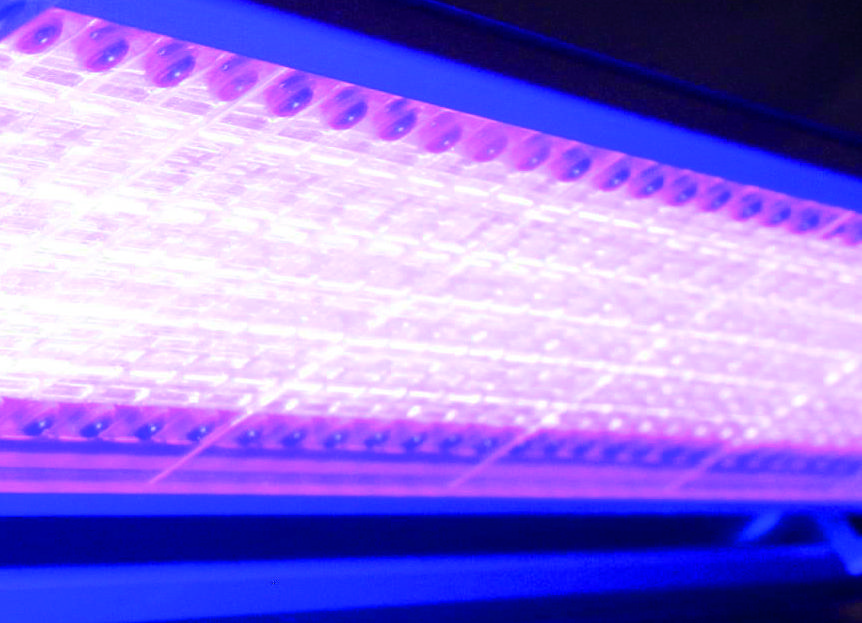
UV drying has many good features, and it appeals to many green print companies.
CyanX offers a number of retrofit options when it comes to UV systems from partners such as Eltosch Grafix and Honle PrintConcept.
There has been plenty of excitement about UV printing for many reason –one of them being its green benefits as its lamps use lower energy than traditional ones.
Most of the manufacturers and suppliers do mention the green angle, but they have been quick to point out that they are not actually marketing it as a ‘green’ technology.
Certainly, the case for it being green is compelling though, with not only energy saving, but savings on waste too, so yes it does have eco friendly elements.
Whilst all manufacturing has some impacts on the environment, whether that be a car, a pair of shoes or a printed product, the best we can hope to do is to cut those impacts to the absolute minimum.
Many of the print and packaging companies that are running UV, or looking to install it, are also those who hold the environment at the heart of their business.
The removal of spray powder, the reduction of paper/substrate waste, the lower energy running, all add up to a compelling story for UV. There is also an upside for UV when it comes to productivity, presses and working environments are cleaner and better for operators, there is less heat in the printroom too.
Making savings
You will save time and money on everything from manpower and resources to energy.
Good for green? Yes. You will find that you have significantly less power consumption; the lamps on UV-LED systems need less energy.
In most cases, lamps also have a longer life that their counterparts.
By far the biggest claim when it comes to sustainability is that UV-LED technology will use less energy – and that is always good, not only for the purse of the print or packaging company, but for the environment too.
Getting quicker
Make ready will be quicker, and up to colour too. Substrates come off the press dry as soon as they come off the press – even materials that are traditionally difficult to cure. This is especially useful in packaging.
Good for green? Yes. The fact that you are up to colour more quickly means less use of set up sheets, so substantial paper and resource waste is saved.
At the other end of the press, there is no waste from sheets that come off tacky and get spoilt, as they come off dry.
Breathing deeply
Operators using these technologies report that they have a better environment in which to work. Presses are cleaner and maintenance easier.
Good for green? Yes. The removal of spray powder not only means a saving of this resource, but also a cleaner and much more pleasant atmosphere for employees to work in.
Higher quality
The output from the press is usually superior when it comes to scratch and rub resistance.
Good for green? Yes. Even quality assurance can help to save on waste. If you jobs are consistent and high quality first time, there is less chance of them being rejected and again waste will be saved.
Thinking ink
UV curable printing inks, to date, can struggle to fulfil criteria for good recyclability. But, new inks are continually being developed that help to address this.
Good for green? Maybe a slight negative here, but it s definitely something that the manufacturers and ink suppliers are working on.
Out of the zone
Cutting alcohol has long been held as a way to cut the impacts of a printing press, and UV-LED enables this.
Good for green? Yes. UV-LED allows users to print alcohol free, with no volatile organic compound emissions (VOCs). There are also no ozone emissions generated.
So, all in all, we would weigh up that UV-LED comes down on the positive side when it comes to the environment and would certainly give it the green light!
As always, if you need any help or advice, please give our friendly sales team a call and they would be happy to help.
Call the team a call on +44 (0) 33 33 21 85 21 or e-mail [email protected]
30th January 2026